Research projects
Towards interpretable and functional phosphene vision for perception and action
- Organisation(s): Netherlands Institute for Neuroscience
- Research area / work package: Neurotechnology hardware
- Type of project: PhD
- Duration: April 2023 - March 2027
- Project owner: Maureen van der Grinten
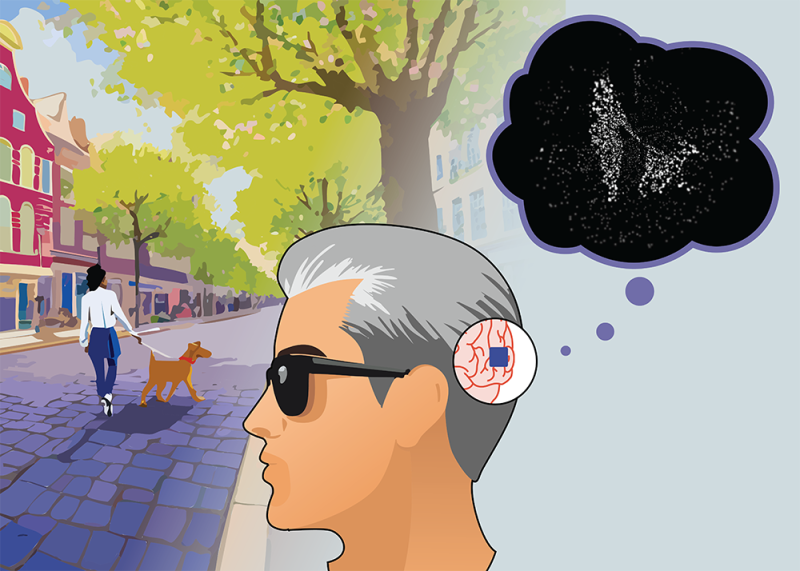
Visual prosthetics are a promising solution to restoring a form of vision for some blind individuals. Electrical stimulation of neural structures in the visual pathway induces the perception of dots of light, called phosphenes. By converting camera input to patterns of electrical stimulation of the visual system, part of the impaired pathway can be bypassed in blind people, allowing for restoration of a rudimentary form of vision through patterned phosphenes. For these implants to function as a prosthesis, it is important that large numbers of electrodes can be stimulated simultaneously, and that these stimulations lead to the perception of interpretable patterns. Significant progress has been made over the past years in terms of numbers of electrodes that can be implanted and areas of the brain that are accessible with implanted arrays. At the Netherlands Institute for Neuroscience, we are testing and developing the newest generations of visual brain implants in non-human primates. Our aim is to better understand what neural processes underlie phosphene perception, and to use this knowledge to produce interpretable and behaviorally relevant perception.
Research areas
Want to join DBI²?
Browse the vacancies page
Contact details
Radboud University
DBI2 Office
Heyendaalseweg 135
6525 AJ Nijmegen
Socials